6–7 Piano Etudes: Turning a Viral Meme into a Fun Way to Teach Scales
Another surprise from this week: 6–7 is still going strong!
If you’ve been around middle and elementary schoolers lately, you’ve probably seen the “6–7” hand motion that means absolutely nothing — except that it’s cool and slightly annoying to adults. 😆
So I did what any self-respecting piano teacher with an “evil plan” would do…
I turned it into a piano etude.
🎵 The 6–7 Piano Etude (Major Edition)
This short, catchy etude uses the C Major scale, with repeated emphasis on the 6th and 7th degrees.
It’s a fun mid-to-late elementary study that builds technique, coordination, and laughter in equal measure.
Students connect instantly — they laugh, they play it again (and again), and they don’t even realize they’re building scale awareness and ear training.
I even add a bit of solfège (do = 1, re = 2, etc.) so students connect the dots between sound and theory.
It’s quick, funny, and perfect for classroom energy resets or mid-lesson refreshers.
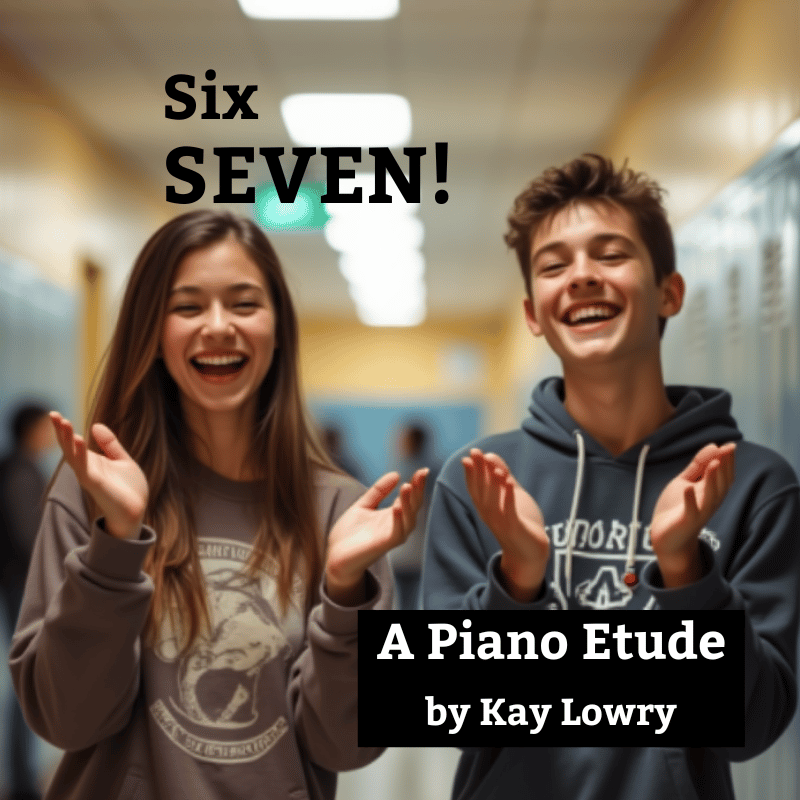
middle school kids driving adults crazy with the hand motions!
🎵 The 6–7 Piano Etude (Minor Edition)
Of course, I couldn’t leave well enough alone.
After teachers started telling me how much their students loved the first version — and were comparing it to minor scales — I knew what I had to do.
So… ta-da! (as one of my autistic students says).
The 6–7 Piano Etude: Minor Edition explores natural, harmonic, and melodic minor scales, helping students see how the 6th and 7th scale degrees shift in each form.
Here’s what’s inside:
✅ Three short etudes (one for each minor form)
✅ Late elementary to early intermediate level
✅ Perfect for warm-ups or scale review
✅ Engaging enough to make students ask to practice
And yes — I had to give the notes sad faces for the minor version! 🎭

Sad faces when they play the minor scale!
Both etudes are still on sale for $2.99, and teachers everywhere are using them to sneak in scale practice disguised as fun.
Because let’s face it — if kids are saying “6–7” anyway, we might as well make it musical. 😉