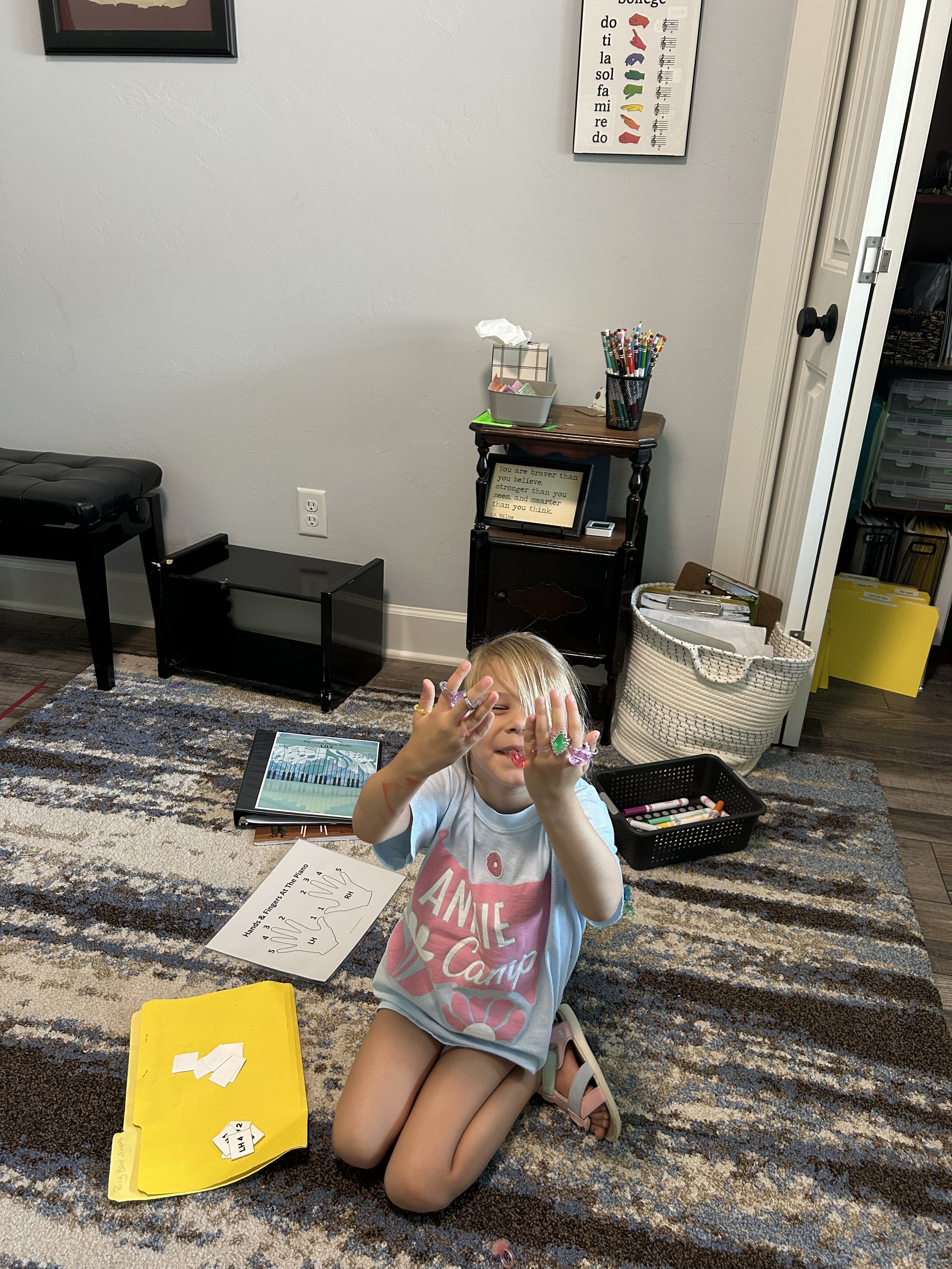
How to Teach Piano Finger Numbers: A Simple Game for Young Beginners
A new four-year-old came for her second piano lesson this week.
We were working on finger numbers.
As you know, finger numbers seem simple to us. But for many young beginners, they're surprisingly hard.
Why young beginners struggle with finger numbers
First, kids have to know their right hand from their left. This is pretty hard for young kids, and deserves another article here.
Then, they have to learn that there are only five finger numbers. I had one student who told me that there were 10 finger numbers, until I showed him my finger number diagram.
It’s also tough for kids to know where to start. Counting from the thumb takes time, but with repetition, it becomes second nature.
My four-year old student was a little confused, until I started playing the most POPULAR game in my studio - The Ring Game.

6–7 Piano Etudes: Turning a Viral Meme into a Fun Way to Teach Scales
Another surprise from this week: 6–7 is still going strong!
If you’ve been around middle and elementary schoolers lately, you’ve probably seen the “6–7” hand motion that means absolutely nothing — except that it’s cool and slightly annoying to adults. 😆
So I did what any self-respecting piano teacher with an “evil plan” would do…
I turned it into a piano etude.
🎵 The 6–7 Piano Etude (Major Edition)
This short, catchy etude uses the C Major scale, with repeated emphasis on the 6th and 7th degrees

🎹 When Overwhelm Meets Purpose: Reclaiming the Heart of Beginner Piano Teaching
🧭 A Clear Path for Every Age and Stage
Whether you’re wondering how to teach piano to a 4-year-old, or what kinds of activities actually work for a 5-year-old beginner, you’ll find answers inside The Piano Expedition.
Each monthly framework includes:
🎵 Age-specific lesson plans — Know exactly what to teach and when.
🎨 Creative off-bench activities — Movement, games, and manipulatives that make learning stick.
🎒 Flexible pacing guides — So you can adjust for every student’s needs.
You’ll know how to guide a 4-year-old through rhythm play and finger numbers… how to help a 5-year-old connect patterns on the keys to notation… and how to keep early learners engaged without burnout.

Thank you for being a friend…
Do you have music teacher friends? Is it even important these days?
Every where I have lived, I have had a community of music teacher friends, or like-minded musicians.
This has taken different forms. Sometimes it was my colleagues at a public school or music academy.
Mostly- I’ve been a member of a local MTA group. (If you don’t know what that is - it is the local group of music teachers that is affiliated with Music Teachers National Association - our US teacher group.)
I’ve had a local group since the late 1990s. Until I didn’t.

6 Steps to Confident Recitals – A Free Resource for Piano Teachers
It’s three weeks before your recital. One student CANNOT remember to bow, another panics when you remove the music from the music rack, and one of your best students keeps rushing the tempo no matter what you have tried.
You’ve scheduled the recital venue. You’ve planned refreshments. You have typed the recital program and checked it. Why won’t these students get with it and learn their music?
You are not alone. I’ve been there. I remember once - I had one of my best students go to the piano during a recital and she could not remember where to put her hands! And she was in junior high! I vowed then and there that I needed a SYSTEM (and this was before this word came into vogue) to turn my students into CONFIDENT performers.